WARNING: Unknown Impersonators Target Correct Capital Wealth Management and CEO Brian I. Pultman on WhatsApp

2026 Tax Planning for High-Income Earners: 8 Strategies to Review Before Year-End
By Johnathan Horman
Your CPA is likely very good at telling you what happened last year. The catch is that by the time they can tell you, the year is closed and almost nothing about it can be changed. For high-income households, the choices that shape a tax bill (like the timing of a bonus or a stock option exercise) usually have to be made before December 31 to count.
That's the definitive line between tax preparation and tax planning. Preparation looks back and reports what already happened. Planning looks ahead at decisions you can still change, while there's time to change them.
And 2026 gives high earners plenty to look ahead at. New Roth catch-up rules took effect for many savers over 50, the state and local tax (SALT) deduction has a higher cap with a new phase-out, the alternative minimum tax has revised thresholds, and charitable deductions come with fresh limits.
On top of the new rules, executives, business owners, and affluent families still have to sort out how bonuses, stock options, capital gains, charitable gifts, and retirement distributions affect one another on a single tax return.
At Correct Capital Wealth Management, we treat tax planning as one part of a comprehensive financial plan, because every tax decision ripples into your investments and your retirement income. Here are eight areas high-income households should review before 2026 wraps up.
We’ll start with immediate income events and move to more long-term wealth transfer strategies.
First, a visual…
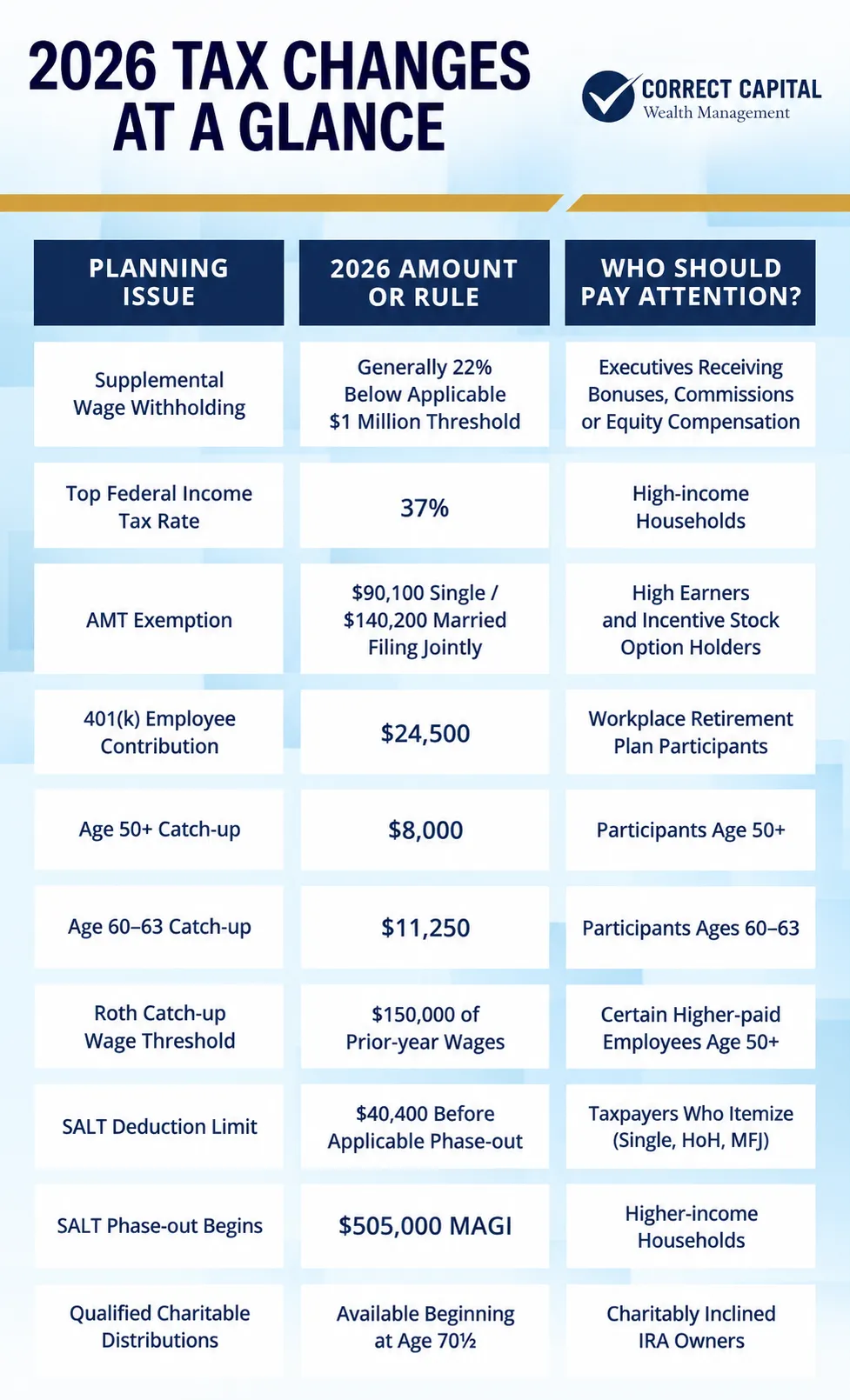 These figures are a useful starting point. The bigger opportunity usually comes from seeing how several rules land on the same financial decision. The IRS publishes full detail in its 2026 federal tax inflation adjustments.
1. Adjust Withholding Early to Avoid Bonus Tax Surprises
A common misconception about bonuses is that the amount your employer withholds matches the tax you'll owe on it. Those two numbers can be far apart. Bonuses, commissions, severance, and certain types of equity compensation can be treated as “supplemental wages,” meaning pay that arrives outside your regular paycheck. Under IRS Publication 15, when an employer identifies those wages separately, it can generally withhold federal income tax at a flat 22%. Once your supplemental wages from one employer pass $1 million for the year, the withholding rate on every dollar above that line generally jumps to 37%.Why can the 22% withholding rate create a surprise?
- Hypothetical example (made up for illustration): An executive receives $300,000 of taxable supplemental pay. At a 22% withholding rate, the employer sends $66,000 to the IRS. If that extra income falls in the executive's 35% federal bracket, the federal tax on it could run closer to $105,000.
What should high-income earners review?
Before year-end, compare your projected total tax for 2026 with what you've paid so far through withholding and estimated payments. The IRS “safe harbor” rules (explained in Publication 505, Tax Withholding and Estimated Tax) spell out how much you need to have paid during the year to avoid underpayment penalties. They call for a close look after a large bonus, an equity compensation event, or a big investment gain. Talk with your tax professional about this crucial aspect of supplemental income taxation.2. Coordinate Stock Option Planning With AMT in 2026
Incentive stock options (ISOs) come with an odd feature: you can create a tax bill without receiving a dollar of cash. The culprit is the alternative minimum tax, or AMT, a second tax calculation that strips out certain breaks and requires some taxpayers to pay whichever result is higher. When you exercise ISOs and keep the shares past year-end, the gap between the stock's market value and your exercise price (often called the “bargain element”) counts as income in the AMT calculation, even though you haven't sold anything. For 2026, the AMT exemption is $90,100 for single filers and $140,200 for married couples filing jointly. That exemption starts shrinking once AMT income reaches $500,000 for single filers and $1 million for joint filers, according to the IRS's 2026 tax inflation adjustments.Why does ISO planning matter?
- Hypothetical example: Picture an executive who exercises a large block of options and holds every share. Nothing is sold and no cash comes in, yet the exercise can still pull the executive into AMT, with the bill due in April.
- Current and projected income
- Your AMT exposure
- Cash available to pay any tax due
- How much of your net worth sits in a single company's stock
- Exercise timing
- Where you expect the share price to go
- How the shares may be taxed when you eventually sell
3. Strategically Utilize Roth Catch-Up Contributions
A major retirement plan change took effect in 2026 for higher-paid employees age 50 and older. If your prior-year wages from the employer sponsoring your plan topped $150,000 (FICA wages only, not other types of income), your catch-up contributions generally must go in as Roth (after-tax) dollars, as long as your plan offers catch-up contributions. The IRS catch-up contribution guidance has the details.What are the 2026 retirement plan contribution limits?
- $24,500: Regular employee contribution limit
- $8,000: Standard catch-up for eligible participants age 50 and older
- $11,250: Catch-up for eligible participants ages 60 through 63
- $72,000: Combined employee and employer limit, before catch-up contributions
4. Remember the SALT Deduction When Timing Income Taxation
The federal deduction for state and local taxes, which covers state income and property taxes, changed significantly. For 2026, many taxpayers who itemize can deduct up to $40,400. That higher cap starts shrinking once modified adjusted gross income (MAGI) passes $505,000. For many filers, MAGI here is the same as the adjusted gross income figure on Form 1040. Each dollar above the threshold trims the SALT cap by 30 cents until it bottoms out at the old $10,000 limit, which happens at $606,333 of MAGI. Married taxpayers filing separately have lower limits and thresholds.Why does this matter for high-income households?
Inside that phase-out range, an extra dollar of income works against you twice: it gets taxed, and it shrinks a deduction you were counting on. If your additional ordinary income is taxed at 35%, and the SALT cap limits your otherwise deductible state and local taxes, an additional $1,000 of income can also eliminate $300 of deductions. That produces $455 of additional federal income tax (an effective marginal rate of 45.5%) before other tax interactions. This illustration does not apply automatically to long-term capital gains, which have separate federal rates, or to taxpayers whose SALT deduction does not affect their final tax liability. This matters most when you control the timing of income, such as a bonus, a capital gain, a stock option exercise, a Roth conversion, business income, or a deferred compensation payout. Shifting one of those events into a different year can move you in or out of the range. It's one reason we build tax considerations into comprehensive financial planning instead of weighing each financial decision on its own.5. Missouri Residents: Revisit Capital-Gain Subtraction
Missouri residents have a new wrinkle to plan around. The State now lets eligible individuals subtract qualifying capital gains reported on their federal return from their Missouri taxable income. Missouri allows eligible individual taxpayers to subtract 100% of federally reported capital gains when calculating Missouri adjusted gross income. The subtraction covers both short-term and long-term capital gains. Ordinary income does not become eligible, simply because capital gains arise from selling an asset. Trusts and entities have different eligibility rules. The Missouri Department of Revenue's capital gains subtraction guidance outlines who qualifies. For investors holding highly appreciated assets, that can change the math on selling.Should I consider a concentrated stock position?
- Hypothetical example: An investor has built up company stock over many years, and the position is now worth $750,000 against a $150,000 cost basis (the amount originally paid). That's about $600,000 of unrealized gain.
What about employer stock inside a 401(k)?
Highly appreciated employer stock held inside a 401(k) or similar plan may qualify for net unrealized appreciation (NUA) treatment. In plain terms, NUA can allow the growth on those shares to be taxed at long-term capital gains rates when you sell, instead of having the full amount taxed as ordinary income like a typical retirement withdrawal. The rules are strict, however, and the execution has to be precise. Here's the trap: Rolling employer stock into an IRA on autopilot can wipe out the option to use NUA on those shares later, so have them analyzed before you complete a rollover, while the choice is still yours.6. Plan Carefully for Nonqualified Deferred Compensation
Nonqualified deferred compensation plans can allow executives to defer compensation into future years, but elections generally must be made before the year the compensation is earned, subject to specific exceptions. As you review year-end enrollment, confirm whether your election applies to 2027 compensation and whether your employer has an earlier deadline. How much to defer is only half the decision. The other half is when you'll receive it.- Hypothetical example: Say you elect today to receive a deferred payout five years from now. By then you might also be retiring, selling a business, exercising stock options, or starting Social Security and a pension. A large deferred compensation distribution landing in that same year could push your income, and your tax rate, far higher than you expected.
7. Understand the New Charitable Giving Rules
Beginning in 2026, itemizers generally can deduct charitable contributions only to the extent they exceed 0.5% of AGI, subject to the other charitable deduction limits. A separate limitation can reduce the benefit of itemized deductions for taxpayers with income in the 37% bracket, generally limiting the benefit attributable to that bracket to about 35 cents per deductible dollar. For charitably inclined families, the timing and method of giving can matter almost as much as the amount. Here are four approaches to look at with your advisor.Should I consider bunching charitable contributions?
Instead of giving a similar amount every year, you might group several years of planned gifts into one year, when itemizing produces a larger benefit. Since the new 0.5% floor applies in every year you itemize, concentrating gifts into fewer years can also reduce how much of your giving falls below it.What are the benefits of donor-advised funds?
A donor-advised fund lets you make a large contribution in one tax year, claim an allowable deduction for that contribution year, (subject to the applicable floors, limits, and substantiation requirements) and recommend grants to charities over the years that follow. It pairs naturally with bunching.How does donating appreciated stock or securities work?
Instead of selling an investment that has grown in value and donating the cash, you can give qualifying shares directly to a charity. Depending on your situation, that may provide a charitable deduction while sidestepping the capital gains tax you'd owe if you sold.What are qualified charitable distributions?
If you're 70½ or older, you may be able to send money straight from an IRA to a qualifying charity through a qualified charitable distribution (QCD). A QCD is generally excluded from your taxable income, which helps whether or not you itemize, and once RMDs begin it can count toward them. Giving purely for a tax break rarely makes sense. If you're already planning to give, though, these tools can help more of each gift reach the causes you care about, which is good stewardship by any measure.8. The Years Between Retirement and RMDs: A Tax-Planning Opportunity
A frequently overlooked tax planning window opens after you stop working. Consider what happens if you retire at 62 or 65:- Your salary ends.
- You may be delaying Social Security.
- A pension may not have started yet.
- RMDs could still be years away.
What strategies should I review during this window?
Depending on your circumstances, these years may open the door to:- Partial Roth conversions, moving pre-tax savings into a Roth account and paying the tax at today's lower rate
- Selling appreciated investments while your capital gains rate is lower
- Managing which tax bracket you land in each year
- Rebalancing your portfolio
- Deciding which investments belong in taxable, pre-tax and Roth accounts
- Charitable planning
- Coordinating Social Security and pension elections
- Preparing for future required minimum distributions
Are Roth conversions a one-time decision?
Actually, Roth conversions are a multi-year decision. Converting as much as possible in one year can backfire by pushing you into a higher bracket. A better approach is often to model several years side by side. As a hypothetical comparison, one scenario might convert $50,000 a year for five years, while another skips conversions entirely and accepts larger taxable required distributions later on. Which path comes out ahead depends on tax rates, account balances, investment returns, Social Security, Medicare premiums (which rise at higher incomes), spending needs and estate planning goals. That's why retirement tax planning works best when several years are modeled together instead of one transaction at a time.How These 2026 Tax Strategies Interact
Each of these eight strategies has its own rulebook, and in a busy year they constantly bump into each other. As examples:- An incentive stock option exercise can trigger AMT in the same year a Roth conversion raises your taxable income.
- Large capital gains can push you into the SALT phase-out range.
- Deferred compensation payment might arrive right on top of both.
- A charitable gift may offset that income differently depending on the year you make it.
- Retirement account withdrawals can affect your Medicare premiums along with your federal tax bill.
A 2026 Year-End Tax Planning Checklist
Before December 31, think back on whether any of these happened to you in 2026:- A significant bonus or jump in compensation
- Restricted stock or other equity compensation vesting
- An incentive stock option exercise
- A large investment sale
- A concentrated stock position you're thinking about diversifying
- Retirement or a significant drop in earned income
- A potential Roth conversion
- Large charitable contributions
- A deferred compensation election or distribution
- A major business transaction
- A significant change in expected taxable income
Build Tax Planning Into Your Broader Financial Plan
For high-income households, “How do I pay the least tax this year?” makes a narrow starting point. A more helpful question is how this year's decisions affect your financial plan 10 or 20 years from now. At Correct Capital Wealth Management, we help clients weigh tax-sensitive decisions alongside their investments, retirement income, executive compensation and charitable goals. That can include modeling Roth conversions, investment gains and losses, concentrated stock positions, retirement distributions, and multi-year income scenarios. When a strategy calls for tax or legal advice, we coordinate with your CPA, attorney, and other professionals to put it into practice.Review Your Plan Before the Calendar Runs Out
Have you received a large bonus, exercised stock options, sold appreciated investments, or retired this year? Maybe a Roth conversion or a charitable gift is on your mind. Updating your projections before December 31 gives you room to act while the year is still open. To learn more about what we can do for you, explore our services here. If you're interested in connecting, call (877) 930-4015, email johnathan@correctcap.com, or reach out online.Frequently Asked Questions
What is the highest federal income tax rate in 2026?
The top federal individual income tax rate remains 37% in 2026. It applies to taxable income above $640,600 for single filers and $768,700 for married couples filing jointly, and the thresholds for every bracket are adjusted for inflation each year. The IRS lists the full brackets in its 2026 tax inflation adjustments.Why did my employer withhold only 22% from my bonus?
Employers can generally withhold a flat 22% federal rate on separately identified supplemental wages up to $1 million a year. That rate is a prepayment, and your real tax depends on your total income and bracket. If you're in a higher bracket, adjusting withholding or making an estimated payment before year-end can help you avoid an unpleasant April. IRS Publication 15 explains the withholding rules.What are the 401(k) contribution limits for 2026?
The regular employee contribution limit is $24,500 in 2026. Eligible participants age 50 and older can add an $8,000 catch-up contribution, and those ages 60 through 63 can add $11,250 instead, subject to plan rules.Do high earners have to make catch-up contributions as Roth monies in 2026?
Generally, yes. Beginning in 2026, employees whose prior-year FICA wages from the employer sponsoring the plan exceeded $150,000 must make any catch-up contributions on a Roth (after-tax) basis. The IRS catch-up contribution guidance covers the details.Does Missouri tax capital gains?
Missouri now allows eligible individual taxpayers to subtract qualifying capital gains reported on their federal return. Because eligibility and effective-date details matter, review the Missouri Department of Revenue's capital gains subtraction guidance and confirm the treatment with your tax professional before you sell.When should I consider a Roth conversion?
Lower-income years are often a good time to look at Roth conversions, including the stretch after retirement but before Social Security, pensions and required minimum distributions push taxable income back up. Spreading conversions over several years can help keep each year's income in a lower bracket, and a financial planner who works with your CPA can model how different conversion amounts play out over time.About Johnathan
Johnathan Horman is a Lead Financial Advisor and Retirement Plan Specialist at Correct Capital Management in Clayton, Missouri. He helps families and business owners invest with confidence, pairing an analytical approach with a calm, consistent commitment to simplifying the complex. He holds an MBA from Saint Louis University and a finance degree from Truman State University, is a registered investment advisor representative (Series 65, life insurance), and sharpened his skills in retirement planning and portfolio management at firms including Wells Fargo Advisors and Northwestern Mutual. Disclosures: The opinions expressed in this program are for general informational purposes only and are not intended to provide specific advice or recommendations for any individual or on any specific security and are subject to change. It is only intended to provide education about the financial industry. To determine which investments may be appropriate for you, consult your financial advisor prior to investing. As always please remember investing involves risk and possible loss of principal capital; please seek advice from a licensed professional. Correct Capital Wealth Management LLC is not a law firm and does not provide legal advice to clients. All Estate planning document preparation and other legal advice are provided through select third parties. Correct Capital Wealth Management, LLC is a registered Investment Adviser registered with the U.S. Securities & Exchange Commission. Advisory services are only offered to clients or prospective clients where Correct Capital Wealth Management, LLC and its representatives are properly licensed or exempt from licensure. No advice may be rendered by Correct Capital Wealth Management, LLC unless a client service agreement is in place.
Correct Capital
Wealth Management
130 S Bemiston Ave,
Suite 602
Clayton, MO 63105
+1 (877) 930-4015
View on Google Maps
Start with a conversation.
Tell us about your goals and a Correct Capital advisor can follow up to arrange an introductory call.
Schedule an Introductory CallServices We Offer
- Retirement Planning Services
- Financial Advice
- 401(k) Rollover
- Financial Portfolio Management
- Retirement Consultant
- Asset Management
- Financial Advisor
- 401k Companies
- Wealth Management
- Rollover 401(k)
- Retirement Planning
- Retirement Calculator
- Social Security Consultants Near Me
- Tax Planning
- Small Business Retirement Plans
- 401(k) For Small Business
- Self-Employed Retirement Plans
- ESOP Advisor
- Company 401(k) Plans
- Fiduciary Financial Advisor
- Succession Planning
- Retirement Plan Consultants
- Financial Planning
- Retirement Planner
- High-Net-Worth Wealth Management
- 401(k) Audit
- Investment Management
- Roth Conversion
- Independent Financial Advisor
- Retirement Financial Planning
- Investment Planning
- Retirement Income Planning
- Comprehensive Financial Planning
- Financial Planning for Business Owners
- Family Wealth Planning
The opinions expressed in this program are for general informational purposes only and are not intended to provide specific advice or recommendations for any individual or on any specific security. It is only intended to provide education about the financial industry. To determine which investments may be appropriate for you, consult your financial advisor prior to investing. As always please remember investing involves risk and possible loss of principal capital; please seek advice from a licensed professional.
Correct Capital Wealth Management is a registered investment adviser. Advisory services are only offered to clients or prospective clients where Correct Capital Wealth Management and its representatives are properly licensed or exempt from licensure. No advice may be rendered by Correct Capital Wealth Management unless a client service agreement is in place.